
Aristolochia grandiflora <br>PELICAN FLOWER, CALICO FLOWER
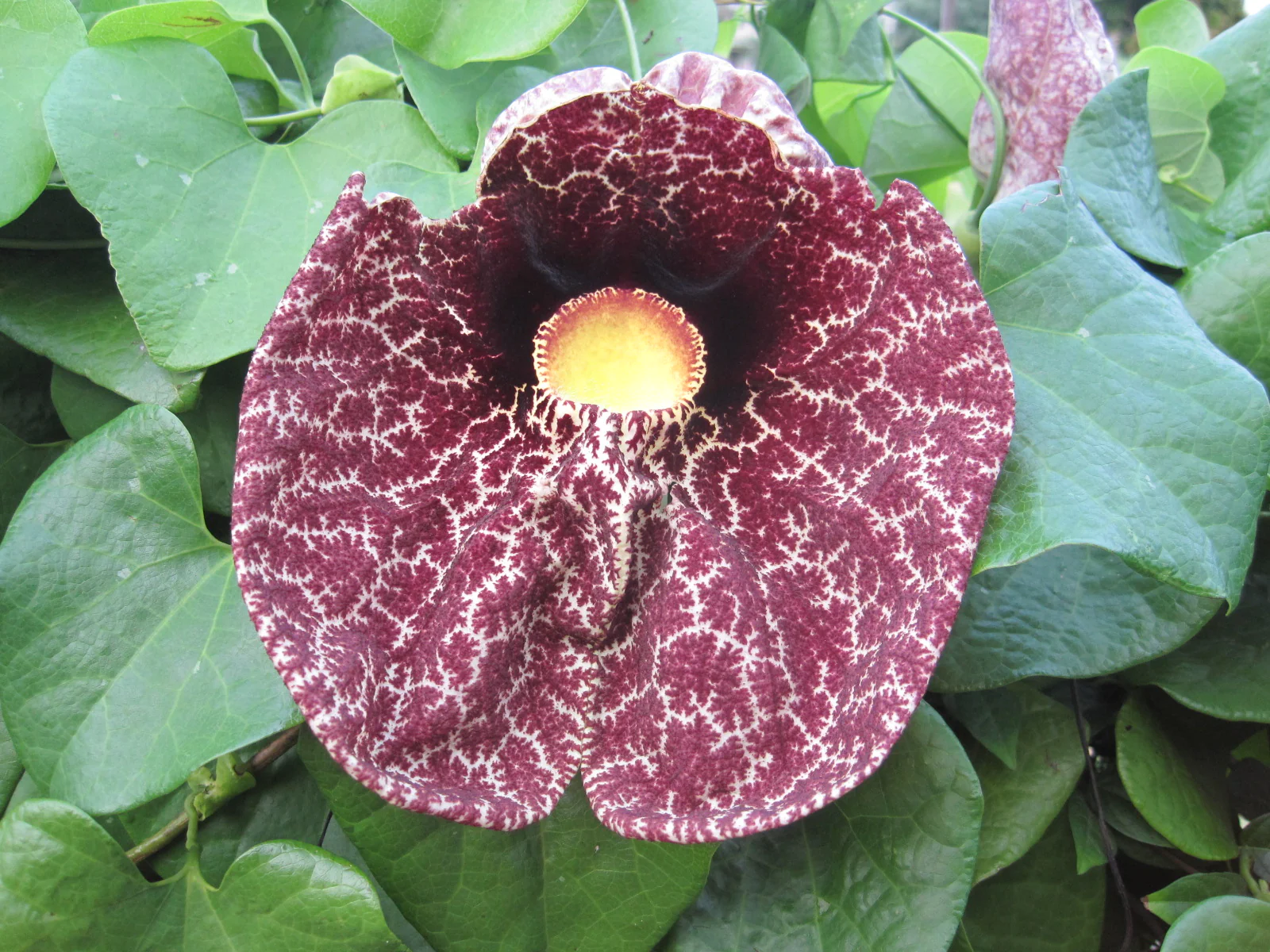
Aristolochia grandiflora, the pelican flower, is a deciduous vine with one of the world's largest flowers! Producing large heart-shaped flowers up to 20 cm (8") wide and have tails that are up to 60cm (24") long. The flower is green/white with purple/brown veins. The center of the flower is darker colored, which attracts pollinators along with a distinctive odor to its reproductive elements!
The flowers emits an odor that smells like rotting meat, attracting flies. Flies travel down the tubular part of the flower to the utricle where the reproductive organs are found. The tube is lined with trichomes that direct the fly down and prevent the fly from moving out. The fly can carry pollen from other flowers to pollinate the carpel. While the fly is trapped, the stamen mature releasing pollen on the fly. This phase lasts one day. While trapped inside the flower, the fly eats nectar produced along the walls of the utricle. The trichomes then are signaled to wither, allowing for the fly to escape.
Aristolochia grandiflora has been used for ornamental purposes. It is also a food source for swallowtail butterfly larvae. These butterflies become unpalatable to predators when they consume the terpenes in this plant.
Type: Perennial vine
Hardiness zones: 10-12
Height: 8-10m
Location: Sun or part shade
Seeds per packet: 3
Charlie Jackson, Pelican Flower (49661386467), CC BY 2.0
Rik Schuiling] / TropCrop-TCS, 2023.12-532-242ap1 sideview of flower of Aristolochia grandiflora (ARIS) in the Singapore Botanic Gardens on sun17dec2023-1230h, CC BY-SA 4.0
Original: $11.14
-65%$11.14
$3.90Product Information
Product Information
Shipping & Returns
Shipping & Returns
Description
Aristolochia grandiflora, the pelican flower, is a deciduous vine with one of the world's largest flowers! Producing large heart-shaped flowers up to 20 cm (8") wide and have tails that are up to 60cm (24") long. The flower is green/white with purple/brown veins. The center of the flower is darker colored, which attracts pollinators along with a distinctive odor to its reproductive elements!
The flowers emits an odor that smells like rotting meat, attracting flies. Flies travel down the tubular part of the flower to the utricle where the reproductive organs are found. The tube is lined with trichomes that direct the fly down and prevent the fly from moving out. The fly can carry pollen from other flowers to pollinate the carpel. While the fly is trapped, the stamen mature releasing pollen on the fly. This phase lasts one day. While trapped inside the flower, the fly eats nectar produced along the walls of the utricle. The trichomes then are signaled to wither, allowing for the fly to escape.
Aristolochia grandiflora has been used for ornamental purposes. It is also a food source for swallowtail butterfly larvae. These butterflies become unpalatable to predators when they consume the terpenes in this plant.
Type: Perennial vine
Hardiness zones: 10-12
Height: 8-10m
Location: Sun or part shade
Seeds per packet: 3
Charlie Jackson, Pelican Flower (49661386467), CC BY 2.0
Rik Schuiling] / TropCrop-TCS, 2023.12-532-242ap1 sideview of flower of Aristolochia grandiflora (ARIS) in the Singapore Botanic Gardens on sun17dec2023-1230h, CC BY-SA 4.0