
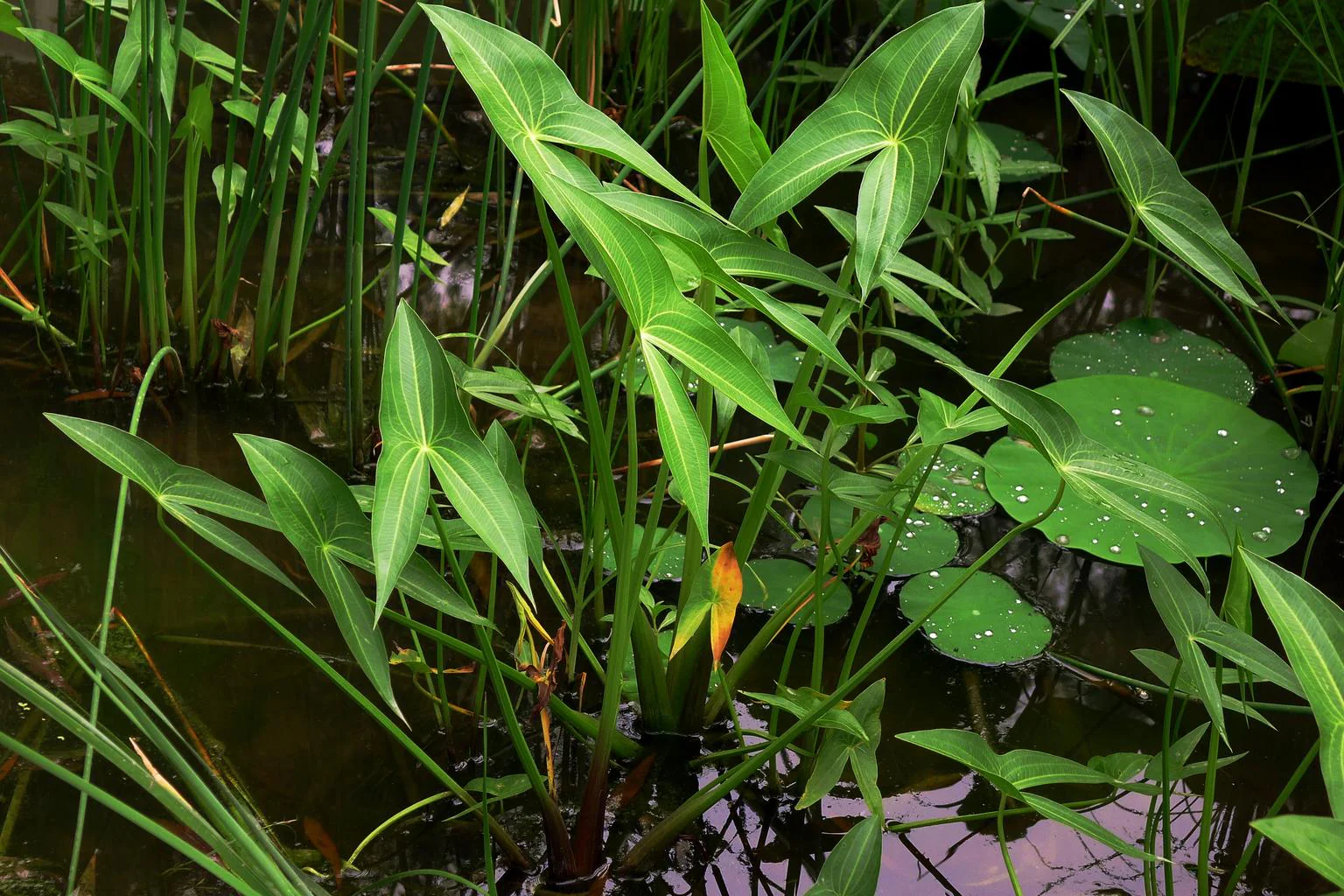
Sagittaria latifolia <br>ARROWHEAD, WAPATO
Sagittaria latifolia is a plant found in shallow wetlands and is sometimes known as broadleaf arrowhead, duck-potato, Indian potato, or wapato. Sagittaria latifolia is a variably sized perennial growing in colonies that can cover large amounts of ground. The roots are white and thin, producing white tubers. The plant produces rosette of leaves, and attractive white flowers on a long scape. Sagittaria latifolia is native to southern Canada and most of the contiguous United States, as well as Mexico, Central America, Colombia, Venezuela, Ecuador, and Cuba. It is also naturalized in Hawaii, Puerto Rico, Bhutan, Australia and much of Europe (France, Spain, Italy, Romania, Germany, Switzerland, the Czech Republic, and European Russia). Extremely frequent as an emergent plant, broadleaf arrowhead forms dense colonies on very wet soils that become more open as the species mixes with other species of deeper water levels. These colonies forms long bands following the curves of rivers, ponds and lakes, well-marked by the dark green color of the leaves. The plant has strong roots and can survive through wide variations of the water level, slow currents and waves. Despite the name duck potato, ducks rarely consume the tubers, which are usually buried too deep for them to reach, although they often eat the seeds. No parts of these plants or seeds are meant for human consumption. This plant is easily cultivated in 0.15 m to 0.45 m of water with no or little current. The tubers are planted well spaced (no more than 12 plants per square meter) at the end of May at a depth of 5 to 7 cm. Fertilize with decomposed manure. They can be multiplied through seeding or division in July.
Hardiness zones: 3-11. They grow in rivers here in Canada.
Type: Hardy perennial water plant
Height: 24-36", 60-90cm
Location: Sun or part sun
Seeds per packet: 100
Original: $5.99
-65%$5.99
$2.10Product Information
Product Information
Shipping & Returns
Shipping & Returns
Description
Sagittaria latifolia is a plant found in shallow wetlands and is sometimes known as broadleaf arrowhead, duck-potato, Indian potato, or wapato. Sagittaria latifolia is a variably sized perennial growing in colonies that can cover large amounts of ground. The roots are white and thin, producing white tubers. The plant produces rosette of leaves, and attractive white flowers on a long scape. Sagittaria latifolia is native to southern Canada and most of the contiguous United States, as well as Mexico, Central America, Colombia, Venezuela, Ecuador, and Cuba. It is also naturalized in Hawaii, Puerto Rico, Bhutan, Australia and much of Europe (France, Spain, Italy, Romania, Germany, Switzerland, the Czech Republic, and European Russia). Extremely frequent as an emergent plant, broadleaf arrowhead forms dense colonies on very wet soils that become more open as the species mixes with other species of deeper water levels. These colonies forms long bands following the curves of rivers, ponds and lakes, well-marked by the dark green color of the leaves. The plant has strong roots and can survive through wide variations of the water level, slow currents and waves. Despite the name duck potato, ducks rarely consume the tubers, which are usually buried too deep for them to reach, although they often eat the seeds. No parts of these plants or seeds are meant for human consumption. This plant is easily cultivated in 0.15 m to 0.45 m of water with no or little current. The tubers are planted well spaced (no more than 12 plants per square meter) at the end of May at a depth of 5 to 7 cm. Fertilize with decomposed manure. They can be multiplied through seeding or division in July.
Hardiness zones: 3-11. They grow in rivers here in Canada.
Type: Hardy perennial water plant
Height: 24-36", 60-90cm
Location: Sun or part sun
Seeds per packet: 100


