
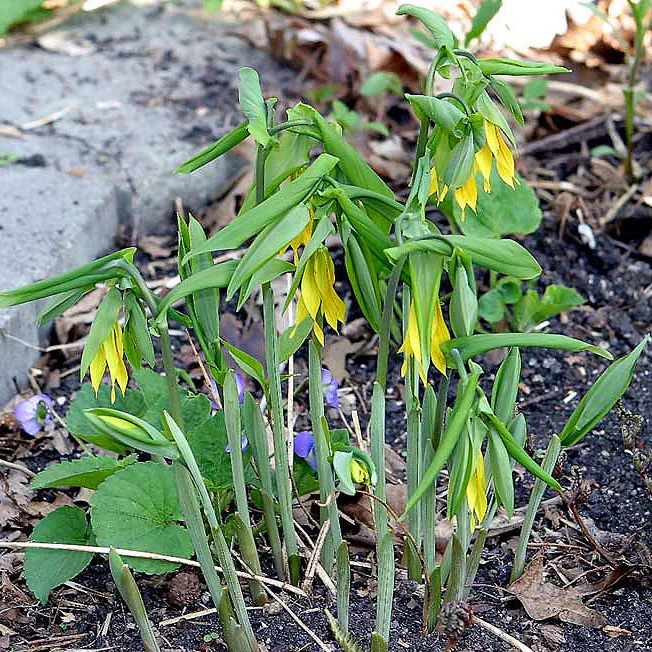
Uvularia grandiflora <br>BELLWORT, MERRYBELLS
The large-flowered bellwort or merrybells, is native to eastern and central North America. It is a rhizomatous perennial with pendent leaves which are hairy on the undersides. It blooms in mid-late spring, producing large yellow, bell-shaped, pendent flowers. The Latin specific epithet grandiflora means "large flowered".
The native range of Uvularia grandiflora extends from the Appalachians west to the Dakotas, Kansas and Oklahoma, from Louisiana and Georgia in the South to Manitoba, Ontario and Quebec in Canada. So, it is widespread across the eastern mountains, the Great Lakes and the Mississippi Valley. There are also isolated populations along Chesapeake Bay in Maryland.
Uvularia grandiflora is a woodland species found in open in rich moist woods with calcareous to neutral soils.
Bumblebees, mason bees, halictid bees, and andrenid bees feed from the nectar and collect pollen from the flowers. Deer love to eat these plants.
The plant is listed as endangered in New Hampshire and Connecticut.
Type: Hardy perennial
Hardiness zones: 3-8
Height: 12"-18", 30-45 cm
Location: Sun or part shade
Seeds per packet: 15
Original: $6.99
-65%$6.99
$2.45Product Information
Product Information
Shipping & Returns
Shipping & Returns
Description
The large-flowered bellwort or merrybells, is native to eastern and central North America. It is a rhizomatous perennial with pendent leaves which are hairy on the undersides. It blooms in mid-late spring, producing large yellow, bell-shaped, pendent flowers. The Latin specific epithet grandiflora means "large flowered".
The native range of Uvularia grandiflora extends from the Appalachians west to the Dakotas, Kansas and Oklahoma, from Louisiana and Georgia in the South to Manitoba, Ontario and Quebec in Canada. So, it is widespread across the eastern mountains, the Great Lakes and the Mississippi Valley. There are also isolated populations along Chesapeake Bay in Maryland.
Uvularia grandiflora is a woodland species found in open in rich moist woods with calcareous to neutral soils.
Bumblebees, mason bees, halictid bees, and andrenid bees feed from the nectar and collect pollen from the flowers. Deer love to eat these plants.
The plant is listed as endangered in New Hampshire and Connecticut.
Type: Hardy perennial
Hardiness zones: 3-8
Height: 12"-18", 30-45 cm
Location: Sun or part shade
Seeds per packet: 15


