Chamaecrista fasciculata <br>PARTRIDGE PEA
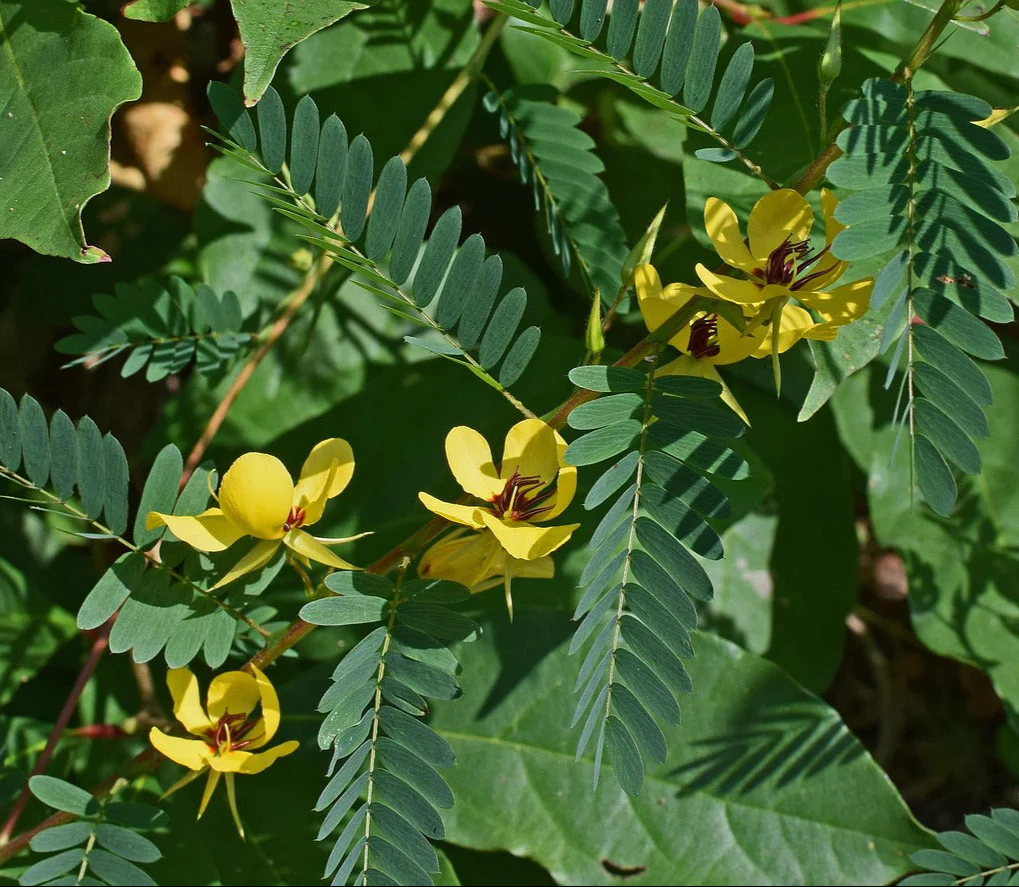
The Partridge Pea, is native to most of the eastern United States. It has bright yellow flowers from early summer until first frost, with flowers through the entire flowering season.
The showy yellow flowers, are about 1 inch (25 mm) across, and bloom July-September. Male and female flowers occur on separate plants, and they are pollinated only by long-tongued bees such as bumblebees, honey bees, long-horned bees, and leafcutting bees pollinate the flowers.
The plants are grown as an ornamental or for honey production, and are also considered an excellent choice for planting in disturbed areas, as it will quickly cover an area, preventing erosion.
The leaves consist of narrow leaflets that are somewhat delicate to the touch. The leaves open and close in response to day and night cycles.
Partridge pea was found to be one of the most important fall and winter foods of bobwhite quail in Alabama. Partridge pea is considered an important honey plant, often occurring where few other honey plants are found. Nectar is produced by small orange glands at the base of each leaf. The common sulfur butterfly lays its eggs on the leaves, and the larvae use the leaves as a food source.
Type: Hardy perennial
Hardiness zones: 3-9
Height: 36", 90cm
Location: Sun to part shade
Seeds per packet: 50
Original: $4.99
-65%$4.99
$1.75Product Information
Product Information
Shipping & Returns
Shipping & Returns
Description
The Partridge Pea, is native to most of the eastern United States. It has bright yellow flowers from early summer until first frost, with flowers through the entire flowering season.
The showy yellow flowers, are about 1 inch (25 mm) across, and bloom July-September. Male and female flowers occur on separate plants, and they are pollinated only by long-tongued bees such as bumblebees, honey bees, long-horned bees, and leafcutting bees pollinate the flowers.
The plants are grown as an ornamental or for honey production, and are also considered an excellent choice for planting in disturbed areas, as it will quickly cover an area, preventing erosion.
The leaves consist of narrow leaflets that are somewhat delicate to the touch. The leaves open and close in response to day and night cycles.
Partridge pea was found to be one of the most important fall and winter foods of bobwhite quail in Alabama. Partridge pea is considered an important honey plant, often occurring where few other honey plants are found. Nectar is produced by small orange glands at the base of each leaf. The common sulfur butterfly lays its eggs on the leaves, and the larvae use the leaves as a food source.
Type: Hardy perennial
Hardiness zones: 3-9
Height: 36", 90cm
Location: Sun to part shade
Seeds per packet: 50