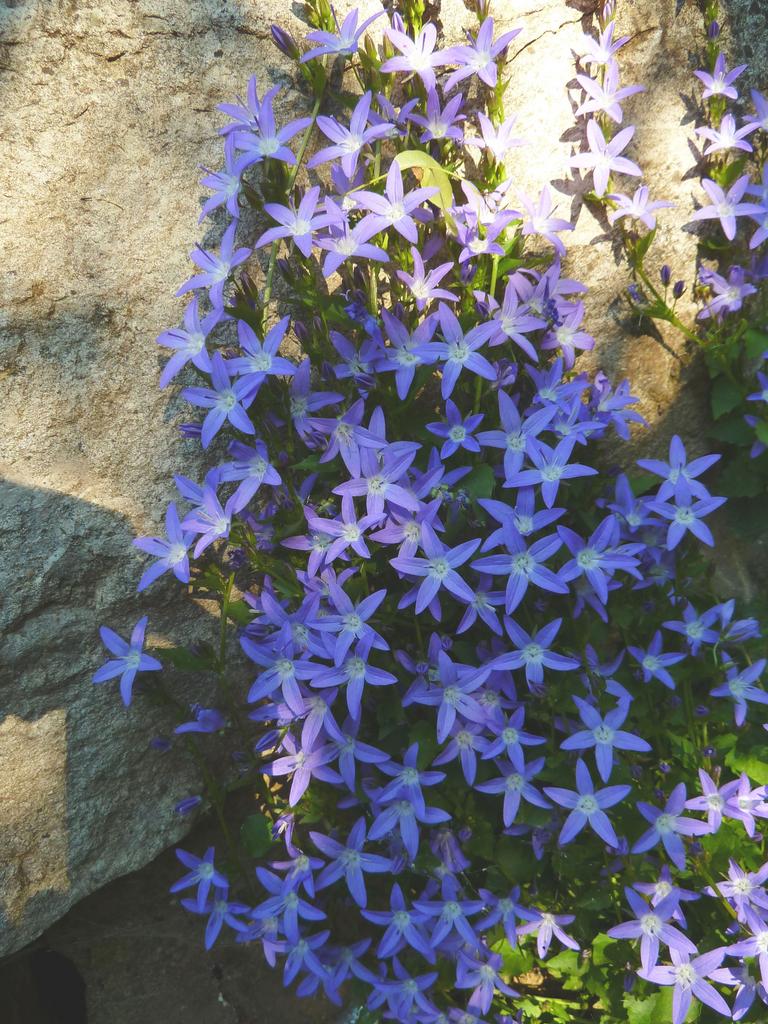

Hedera helix <br>ENGLISH IVY
Hedera helix, the common ivy, English ivy, European ivy, or just ivy, is an evergreen climbing plant, growing to 20-30 m (66-98 ft) high where suitable surfaces (trees, cliffs, walls) are available, and also growing as groundcover where no vertical surfaces occur. It climbs by means of aerial rootlets with matted pads which cling strongly to the substrate. The ability to climb on surfaces varies with the plants variety and other factors: Hedera helix prefers non-reflective, darker and rough surfaces. It generally thrives in a wide range of soil pH with 6.5 being ideal, prefers moist, shady locations and avoids exposure to direct sunlight.
The flowers are produced from late summer until late autumn, 3-to-5 cm-diameter (1.2-to-2.0 in), greenish-yellow, and very rich in nectar, an important late autumn food source for bees and other insects. The fruit are purple-black to orange-yellow berries 6-8 mm (0.2-0.3 in) in diameter, ripening in late winter, and are an important food source for many birds.
Poisonous to people, seeds and/or plants.
Type: Hardy perennial vine
Hardiness zones: 4-9
Height: 20-30m, 66-98'
Location: Part sun to shade
Seeds per packet: 10 Berries (berries contain 3-4 seeds each)
Original: $5.94
-65%$5.94
$2.08Product Information
Product Information
Shipping & Returns
Shipping & Returns
Description
Hedera helix, the common ivy, English ivy, European ivy, or just ivy, is an evergreen climbing plant, growing to 20-30 m (66-98 ft) high where suitable surfaces (trees, cliffs, walls) are available, and also growing as groundcover where no vertical surfaces occur. It climbs by means of aerial rootlets with matted pads which cling strongly to the substrate. The ability to climb on surfaces varies with the plants variety and other factors: Hedera helix prefers non-reflective, darker and rough surfaces. It generally thrives in a wide range of soil pH with 6.5 being ideal, prefers moist, shady locations and avoids exposure to direct sunlight.
The flowers are produced from late summer until late autumn, 3-to-5 cm-diameter (1.2-to-2.0 in), greenish-yellow, and very rich in nectar, an important late autumn food source for bees and other insects. The fruit are purple-black to orange-yellow berries 6-8 mm (0.2-0.3 in) in diameter, ripening in late winter, and are an important food source for many birds.
Poisonous to people, seeds and/or plants.
Type: Hardy perennial vine
Hardiness zones: 4-9
Height: 20-30m, 66-98'
Location: Part sun to shade
Seeds per packet: 10 Berries (berries contain 3-4 seeds each)