
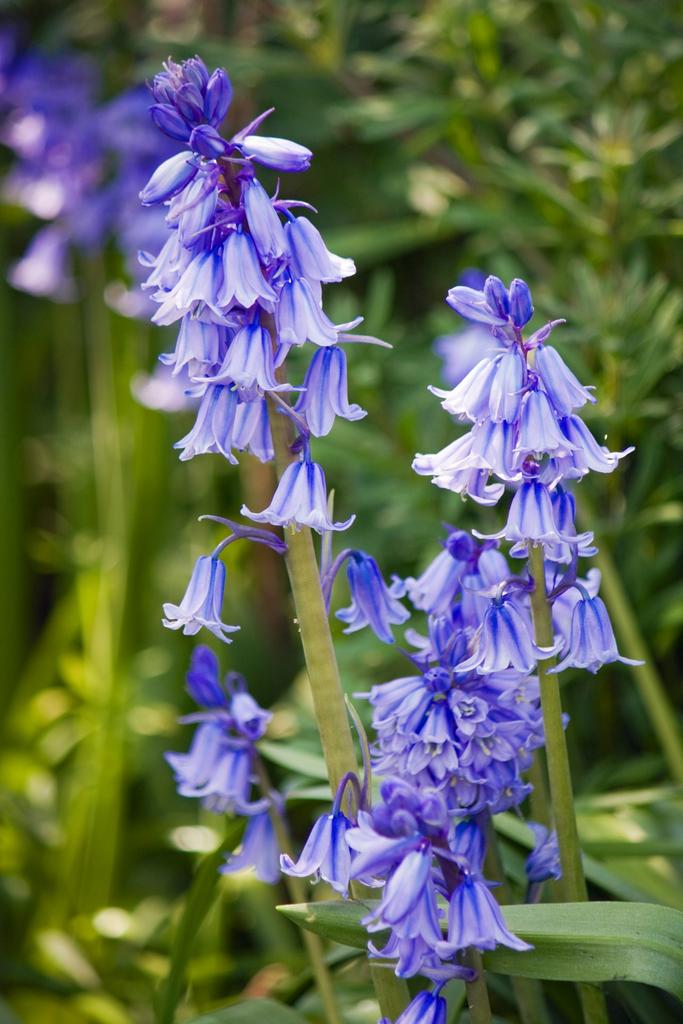
Hyacinthoides non-scripta <br>ENGLISH WOODLAND BLUEBELL
Woodland Bluebells are widely planted as garden plants, either among trees or in herbaceous borders. They flower at the same time as hyacinths, Narcissus and some tulips. Their ability to reproduce vegetatively, using bulb offsets and seed, means that they can spread to form drifts.
Hyacinthoides non-scripta is a perennial plant that grows from a bulb. It produces 3-6 linear leaves, all growing from the base of the plant. An inflorescence of 5-12 (exceptionally 3-32) flowers is borne on a stem up to 500 mm (20 in) tall, which droops towards the tip. Each flower is 14-20 mm (0.55-0.79 in) long. The six tepals are strongly recurved at their tips. The flowers are strongly and sweetly scented. The seeds are black, and germinate on the soil surface.
The bluebell may be regarded as the United Kingdom's "favourite flower". When the wild plant charity Plantlife organised a survey in 2004 to find a favourite flower for each county in the United Kingdom, it decided to ban voters from choosing the bluebell because it had been by far the top choice in an earlier poll for the nation's favourite flower. A stylised bluebell is used as the logo for the Botanical Society of Britain and Ireland.
H. non-scripta differs from H. hispanica, which occurs as an introduced species in the British Isles, in a number of ways. H. hispanica has paler flowers which are borne in radially symmetrical racemes; their tepals are less recurved, and are only faintly scented.
Type: Hardy perennial
Hardiness zones: 3-9
Height: 20"
Location: Sun or shade
Seeds per packet: 20
Product Information
Product Information
Shipping & Returns
Shipping & Returns
Description
Woodland Bluebells are widely planted as garden plants, either among trees or in herbaceous borders. They flower at the same time as hyacinths, Narcissus and some tulips. Their ability to reproduce vegetatively, using bulb offsets and seed, means that they can spread to form drifts.
Hyacinthoides non-scripta is a perennial plant that grows from a bulb. It produces 3-6 linear leaves, all growing from the base of the plant. An inflorescence of 5-12 (exceptionally 3-32) flowers is borne on a stem up to 500 mm (20 in) tall, which droops towards the tip. Each flower is 14-20 mm (0.55-0.79 in) long. The six tepals are strongly recurved at their tips. The flowers are strongly and sweetly scented. The seeds are black, and germinate on the soil surface.
The bluebell may be regarded as the United Kingdom's "favourite flower". When the wild plant charity Plantlife organised a survey in 2004 to find a favourite flower for each county in the United Kingdom, it decided to ban voters from choosing the bluebell because it had been by far the top choice in an earlier poll for the nation's favourite flower. A stylised bluebell is used as the logo for the Botanical Society of Britain and Ireland.
H. non-scripta differs from H. hispanica, which occurs as an introduced species in the British Isles, in a number of ways. H. hispanica has paler flowers which are borne in radially symmetrical racemes; their tepals are less recurved, and are only faintly scented.
Type: Hardy perennial
Hardiness zones: 3-9
Height: 20"
Location: Sun or shade
Seeds per packet: 20


