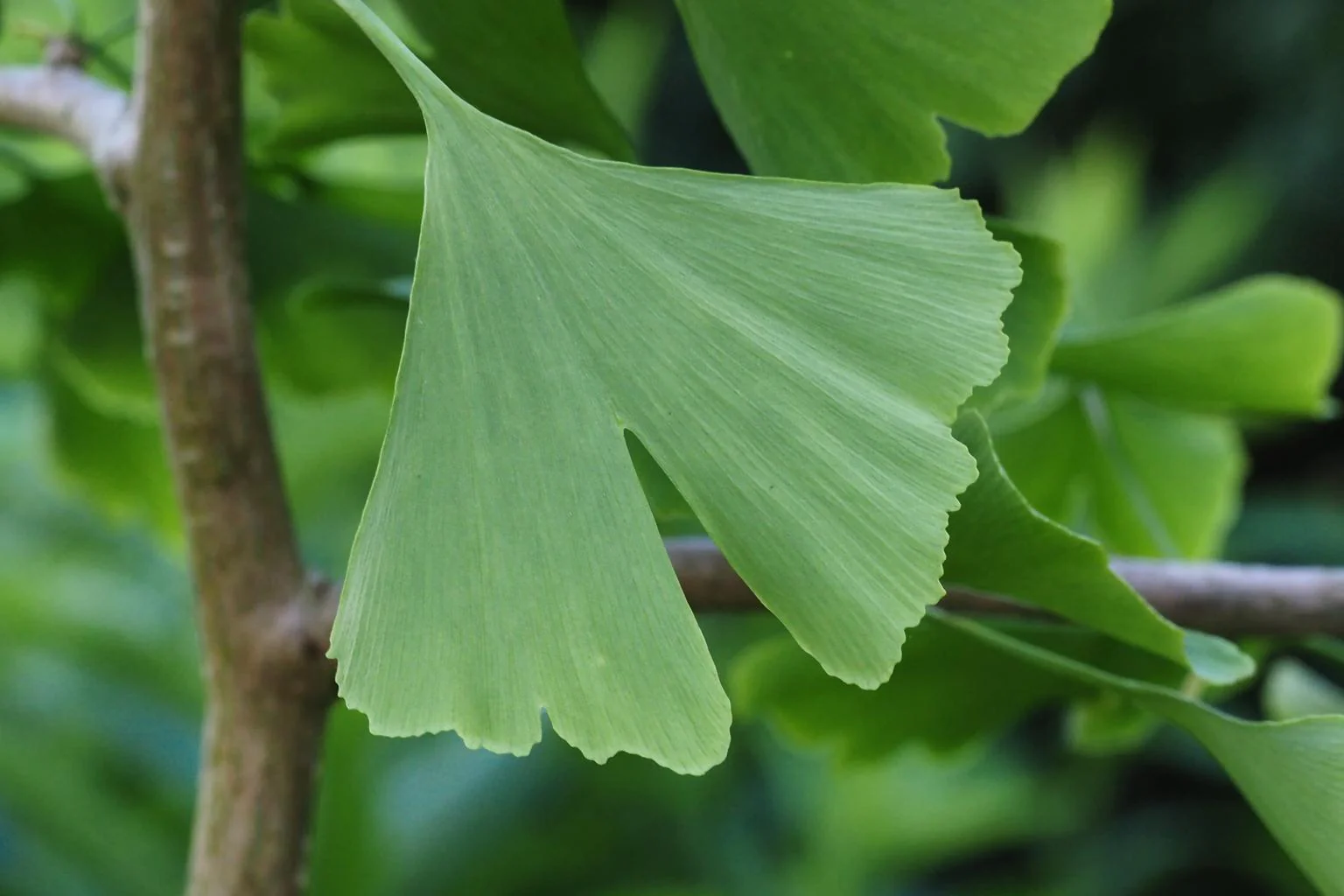
Ginkgo biloba <br>DINOSAUR FOOD, Maidenhair Tree
Ginkgo biloba, commonly known as ginkgo or gingko, also known as the ginkgo tree or the maidenhair tree, is the only living species in the division Ginkgophyta, all others being extinct. It is found in fossils dating back 270 million years. Native to China, the tree is widely cultivated and was introduced early to human history.
Some living trees are believed to be over 1,500 years old. The first record of Europeans encountering it is in 1690 in Japanese temple gardens, the ginkgo is also widely planted in Korea and parts of Japan; in both areas, some naturalization has occurred, with ginkgos seeding into natural forests.
Ginkgos adapt well to the urban environment, tolerating pollution and confined soil spaces. They rarely suffer disease problems, even in urban conditions, and are attacked by few insects. For this reason, and for their general beauty, ginkgos are widely planted along many streets.
Ginkgos are also popular subjects for growing as penjing and bonsai; they can be kept artificially small and tended over centuries. Furthermore, the trees are easy to propagate from seed.
Type: Hardy tree
Hardiness zones: 3-9
Seeds per packet: 5 Large seeds
Product Information
Product Information
Shipping & Returns
Shipping & Returns
Description
Ginkgo biloba, commonly known as ginkgo or gingko, also known as the ginkgo tree or the maidenhair tree, is the only living species in the division Ginkgophyta, all others being extinct. It is found in fossils dating back 270 million years. Native to China, the tree is widely cultivated and was introduced early to human history.
Some living trees are believed to be over 1,500 years old. The first record of Europeans encountering it is in 1690 in Japanese temple gardens, the ginkgo is also widely planted in Korea and parts of Japan; in both areas, some naturalization has occurred, with ginkgos seeding into natural forests.
Ginkgos adapt well to the urban environment, tolerating pollution and confined soil spaces. They rarely suffer disease problems, even in urban conditions, and are attacked by few insects. For this reason, and for their general beauty, ginkgos are widely planted along many streets.
Ginkgos are also popular subjects for growing as penjing and bonsai; they can be kept artificially small and tended over centuries. Furthermore, the trees are easy to propagate from seed.
Type: Hardy tree
Hardiness zones: 3-9
Seeds per packet: 5 Large seeds