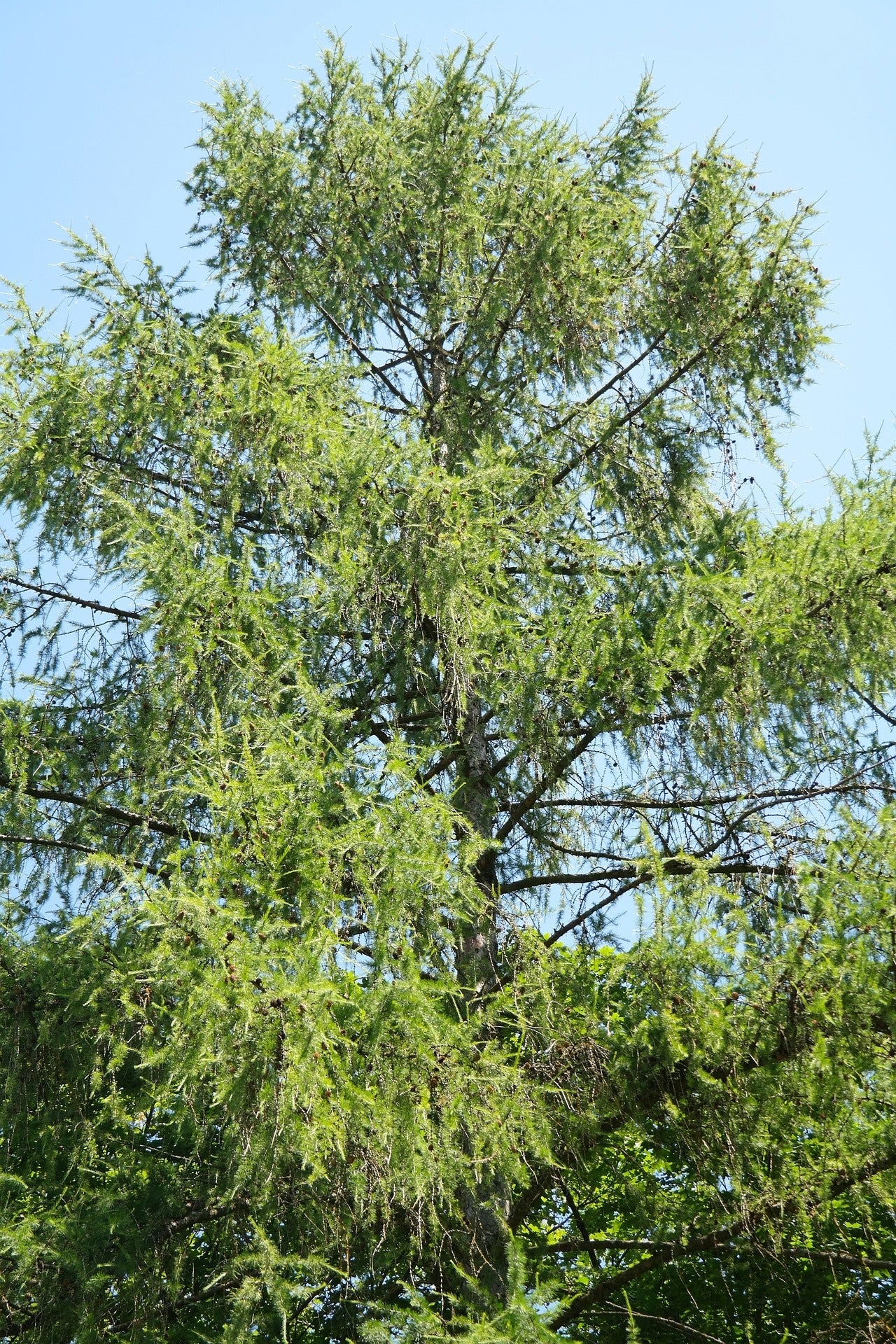
Larix laricina <br>TAMARAC LARCH
Larix laricina, commonly known as the Tamarack, or Larch, is a species of larch native to Canada, and also south into the upper northeastern United States from Minnesota to Cranesville Swamp, West Virginia; there is also an isolated population in central Alaska.
At full size, Larix laricina is a small to medium-size boreal coniferous and deciduous tree reaching 10-20 m (33-66 ft) tall, with a trunk up to 60 cm (24 in) diameter. Tamaracks and larches (Larix species) are deciduous conifers. The cones are bright red!
Tamaracks are very cold tolerant, able to survive temperatures down to at least -65 C (-85 F), and commonly occurs at the Arctic tree line at the edge of the tundra. Trees in these severe climatic conditions are smaller than farther south, often only 5 m (15 ft) tall. They can tolerate a wide range of soil conditions but grow most commonly in swamps, bogs, or muskegs, in wet to moist organic soils such as sphagnum, peat, and woody peat. They are also found on mineral soils that range from heavy clay to coarse sand; thus texture does not seem to be limiting. Although tamarack can grow well on calcareous soils, it is not abundant on the limestone areas of eastern Ontario.
These seeds can also be used for Bonsai!
Seeds per packet: 50
Product Information
Product Information
Shipping & Returns
Shipping & Returns
Description
Larix laricina, commonly known as the Tamarack, or Larch, is a species of larch native to Canada, and also south into the upper northeastern United States from Minnesota to Cranesville Swamp, West Virginia; there is also an isolated population in central Alaska.
At full size, Larix laricina is a small to medium-size boreal coniferous and deciduous tree reaching 10-20 m (33-66 ft) tall, with a trunk up to 60 cm (24 in) diameter. Tamaracks and larches (Larix species) are deciduous conifers. The cones are bright red!
Tamaracks are very cold tolerant, able to survive temperatures down to at least -65 C (-85 F), and commonly occurs at the Arctic tree line at the edge of the tundra. Trees in these severe climatic conditions are smaller than farther south, often only 5 m (15 ft) tall. They can tolerate a wide range of soil conditions but grow most commonly in swamps, bogs, or muskegs, in wet to moist organic soils such as sphagnum, peat, and woody peat. They are also found on mineral soils that range from heavy clay to coarse sand; thus texture does not seem to be limiting. Although tamarack can grow well on calcareous soils, it is not abundant on the limestone areas of eastern Ontario.
These seeds can also be used for Bonsai!
Seeds per packet: 50