Camellia sinensis <br>TEA PLANT SHRUB
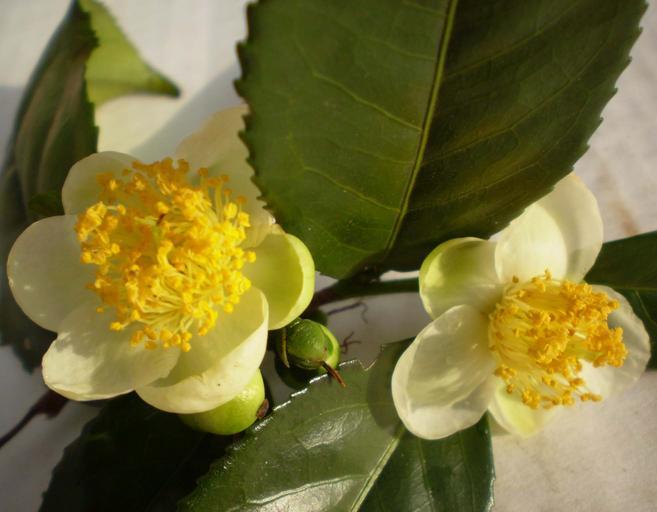
Camellia sinensis is a species of evergreen shrubs or small trees in the flowering plant family Theaceae whose leaves and leaf buds are used to produce tea. Common names include "tea plant", "tea shrub", and "tea tree" (not to be confused with Melaleuca alternifolia, the source of tea tree oil, or Leptospermum scoparium, the New Zealand tea tree).
White tea, yellow tea, green tea, oolong, dark tea (which includes pu-erh tea) and black tea are all harvested from one or the other, but are processed differently to attain varying levels of oxidation. Kukicha (twig tea) is also harvested from C. sinensis, but uses twigs and stems rather than leaves.
The leaves are 4-15 cm (1.6-5.9 in) long and 2-5 cm (0.79-1.97 in) broad. Fresh leaves contain about 4% caffeine, as well as related compounds including theobromine. The young, light-green leaves are preferably harvested for tea production; they have short, white hairs on the underside. Older leaves are deeper green. Different leaf ages produce differing tea qualities, since their chemical compositions are different. Usually, the tip (bud) and the first two to three leaves are harvested for processing. This hand picking is repeated every one to two weeks.
Tea plants prefer a rich and moist growing location in full to part sun, and can be grown in hardiness zones 7 to 9. Tea plants will grow into a tree if left undisturbed, but cultivated plants are pruned to waist height for ease of plucking.
Type: Hardy tree
Hardiness zones: 7-9
Height: Generally up to 16', 4.8m though can be kept shorter with pruning
Location: Sun or part sun
Seeds per packet: 10 large seeds
Original: $7.42
-65%$7.42
$2.60Product Information
Product Information
Shipping & Returns
Shipping & Returns
Description
Camellia sinensis is a species of evergreen shrubs or small trees in the flowering plant family Theaceae whose leaves and leaf buds are used to produce tea. Common names include "tea plant", "tea shrub", and "tea tree" (not to be confused with Melaleuca alternifolia, the source of tea tree oil, or Leptospermum scoparium, the New Zealand tea tree).
White tea, yellow tea, green tea, oolong, dark tea (which includes pu-erh tea) and black tea are all harvested from one or the other, but are processed differently to attain varying levels of oxidation. Kukicha (twig tea) is also harvested from C. sinensis, but uses twigs and stems rather than leaves.
The leaves are 4-15 cm (1.6-5.9 in) long and 2-5 cm (0.79-1.97 in) broad. Fresh leaves contain about 4% caffeine, as well as related compounds including theobromine. The young, light-green leaves are preferably harvested for tea production; they have short, white hairs on the underside. Older leaves are deeper green. Different leaf ages produce differing tea qualities, since their chemical compositions are different. Usually, the tip (bud) and the first two to three leaves are harvested for processing. This hand picking is repeated every one to two weeks.
Tea plants prefer a rich and moist growing location in full to part sun, and can be grown in hardiness zones 7 to 9. Tea plants will grow into a tree if left undisturbed, but cultivated plants are pruned to waist height for ease of plucking.
Type: Hardy tree
Hardiness zones: 7-9
Height: Generally up to 16', 4.8m though can be kept shorter with pruning
Location: Sun or part sun
Seeds per packet: 10 large seeds